
Short answer: A reef tank dosing pump can support a repeatable aquarium routine, but the pump must be matched to measured needs and documented limits. The Dosingpump listing describes a Jebao DP-2 two-head configuration for marine and coral aquarium use, with a listed peristaltic design and plastic construction. It does not state the flow rate, maximum head height, dosing accuracy, calibration process, tubing material, chemical compatibility, voltage, power supply or certification. A sensible reef-tank buyer therefore starts with water-quality records and the liquid route, then confirms whether the missing pump details are acceptable before connecting it to a live system.
Define the reef-tank dosing task
Start by writing down the reef tank's actual maintenance question. A pump may be considered for a repeated addition, but the required volume and timing depend on the aquarium, livestock, water tests and chosen product. The current listing does not name a supplement, liquid or dosing recipe, so do not attach a chemical claim to the pump itself.
The page's marine and coral positioning is relevant to the setting, while OATA's marine water-quality guidance is relevant to the care process. Together they support a cautious workflow: test, record, adjust deliberately and observe the tank after a change.
| Reef-tank check | Documented or required decision | Do not assume |
|---|---|---|
| Number of lines | Two-head configuration | That two heads suit every dosing plan |
| Liquid | No liquid is named on the listing | Chemical compatibility from pump type |
| Delivery route | No head-height or tubing limit is stated | That any height or line will work |
| Result | Water quality still needs monitoring | That a schedule proves the dose is correct |
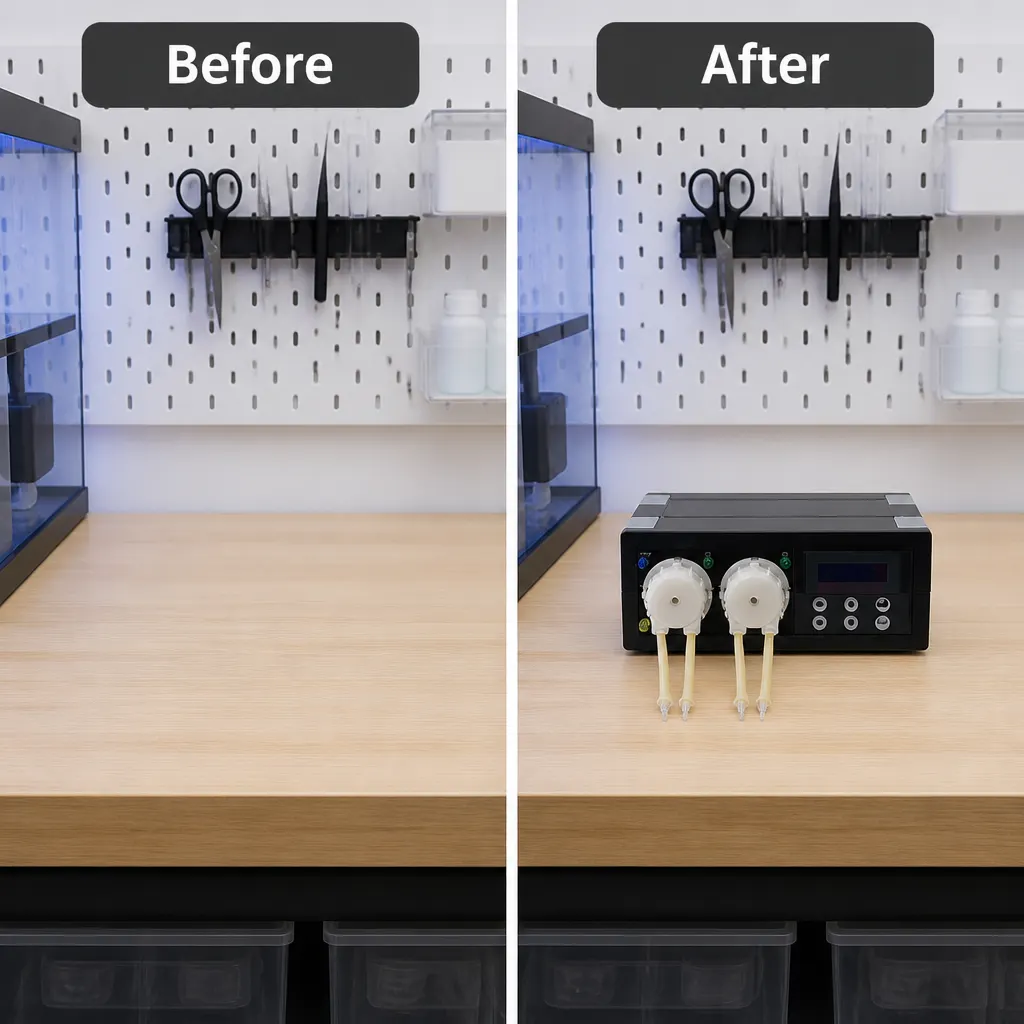
Check the line and reservoir arrangement
Measure the path from each reservoir to the point of delivery. Note the vertical lift, line length, bends and whether the outlet can sit above or below the reservoir. The manufacturer does not specify maximum head height, tubing size, anti-siphon behaviour or a priming method, so ask for those details before building a permanent route.
Use clear labels and keep reservoirs closed against contamination where the aquarium plan requires it. Plastic construction does not identify every wetted material, and the listing does not establish compatibility with saltwater, supplements, additives or cleaning agents.
- Record the intended addition and the reason for it in the reef-tank log.
- Measure each line route and compare it with the seller's written tubing and head limits.
- Confirm the power supply, voltage and controller instructions for the exact product.
- Prime and verify each line using the documented method, keeping the outlet controlled.
- Compare the delivered amount with the intended amount before allowing routine use.
Use testing to judge the result
A reef system can change for reasons unrelated to the pump: evaporation, water changes, livestock demand, maintenance, contamination or an inaccurate test. OATA's care sheet describes testing for water quality in a marine aquarium, so keep a dated record of the parameter, test method, dose change and observed response.
Do not describe an unverified pump schedule as stable, precise or safe for every coral system. The product page does not publish repeatability, calibration interval, alarm behaviour or a maximum daily dose.
Limits and checks before buying
The DP-2 listing may suit a buyer who specifically wants a two-head marine or coral aquarium format and can confirm the missing installation facts. It should not be selected on the assumption that a peristaltic design guarantees a particular dose or that plastic construction proves chemical resistance.
The manufacturer does not specify flow, head, accuracy, calibration, tubing, chemical compatibility, voltage, power supply, runtime or certification. If the reef plan depends on any one of those values, pause the order until the exact manual or written seller response answers it.
Related guides and product details
For a reef tank dosing pump, let water-quality records define the routine and let the written specification define whether the DP-2 can deliver it. Read Two-Head Dosing Pump Aquarium: What to Verify for related guidance. Read Aquarium Dosing Pump UK: Check the Evidence First for related guidance. Review the documented specification on the Jebao dp-2 two-head marine aquarium dosing pump product page before ordering.
Sources and safety context
- Supports the DP-2 two-head format, marine and coral aquarium positioning, peristaltic description and plastic construction. Current Dosingpump aquarium dosing pump product page.
- Supports a test-led approach to monitoring marine aquarium water quality. How to test for water quality in a marine tank or aquarium.